CF
Candle filter
Fine closed-vessel stage behind the magnetic pre-stage.

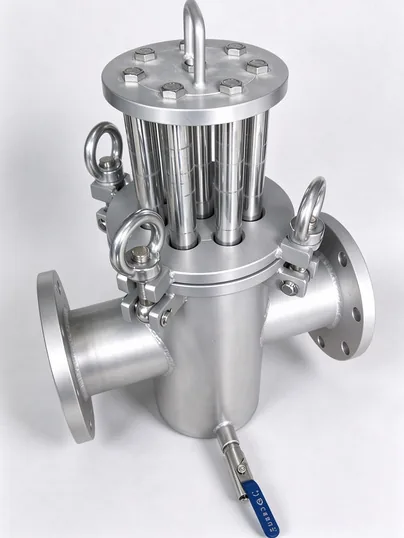
MF · OZZO FilterMagnet
Permanent magnet rods remove rust, iron swarf and ferrous fines as a pre-stage ahead of fine filtration.
Chosen where ferrous contamination can damage product or downstream elements. Magnet rods capture ferrous particles; a quick-open cover or sanitary clamp allows cleanout. It is installed ahead of the fine stage rather than as the final clarifier.
Oils, slurries, food and pharma fluids, and chemical fluids carrying ferrous contamination.
Working principle, advantages, parameters, construction options and application range for this series.
Removes rust, iron swarf and other ferromagnetic fines from liquids to improve purity and protect key equipment. The core magnetic bars are NdFeB strong permanent magnets with a magnetic circuit optimized by 3D finite-element analysis. The all-stainless structure has bars continuously welded or threaded to the cover; a quick-open cover or sanitary clamp allows easy removal and cleaning.
| Item | Specification |
|---|---|
| Housing material | 304 / 316L |
| Magnetic field | 8,000–16,000 Gauss (surface field peak > 12,000 Gauss) |
| Inlet / outlet connection | DN25–DN500 |
| Design temperature | < 80 ℃ (high-temperature custom) |
| Design pressure | 0.6–1.6 MPa |
Fine closed-vessel stage behind the magnetic pre-stage.
Clarification stage behind the magnetic pre-stage.
Follow a market page for the staged layout and condition basis behind this series.
Parameters below follow the selected construction; final rating, size, temperature, pressure and flow are confirmed against the selected model and process conditions.
Questions buyers most often ask before selecting this series.
Send the medium name and concentration, temperature, working pressure, flow rate, target filtration rating, existing inlet/outlet size and connection, and whether the duty is continuous or batch. If you have a line sketch or pressure-drop record, attach it; we reply with the series, stage arrangement and element direction rather than a generic brochure.
Housing and wetted materials are selected against the actual chemical list, temperature and solids load. The materials listed on this page are the common options; seals and non-metal parts are chosen to match the medium, and the final selection is confirmed in the offer against your process data.
Replacement screens, baskets, bags, cartridges and wear parts are supplied to match the selected model. The change-out interval depends on solids loading and differential pressure; keep the model number and interface on record so the correct spare can be matched.
It only captures ferrous and strongly magnetic particles such as rust, iron swarf and steel fines. Non-magnetic solids — sand, scale, polymer beads, non-ferrous metal — still need a basket, bag, cartridge or self-cleaning stage upstream or downstream.
Cleaning frequency follows the iron load and differential pressure; the rods are pulled and wiped or rinsed. Field strength and rod layout are sized to the flow and expected ferrous content.
Share the medium, target rating, temperature and existing interface. We reply with a staged layout and the element direction, not a brochure.